Ali stood up yesterday by himself! I mean, it was only for a few seconds. Then he folded over sideways onto his bed like a drunken sailor. And his back legs were not in a normal position (they were too close together and kind of in a line, one behind the other), BUT he pushed himself into a standing position all by himself!! I was gathering my things to leave work at the end of the day and Ali was being his usual I-know-we’re-getting-ready-to-go-somewhere restless self and I turned around and he was actually standing up on his bed. Aghast, I said “Oh my god – are you standing up??” I wish I had my camera ready, but I didn’t. I don’t think I would have had time to snap a picture anyway. Needless to say, I was thrilled and he looked pretty pleased with himself! Lately he has been doing a good job pushing himself up with his left leg to change positions on his bed and a few times it looked like he was trying to stand for sure. But this is the first time he has actually succeeded. And I think that’s awesome…even if it was just for a few seconds!!
Category Archives: Milestones/Progress
Ah, moving…does it ever go smoothly?
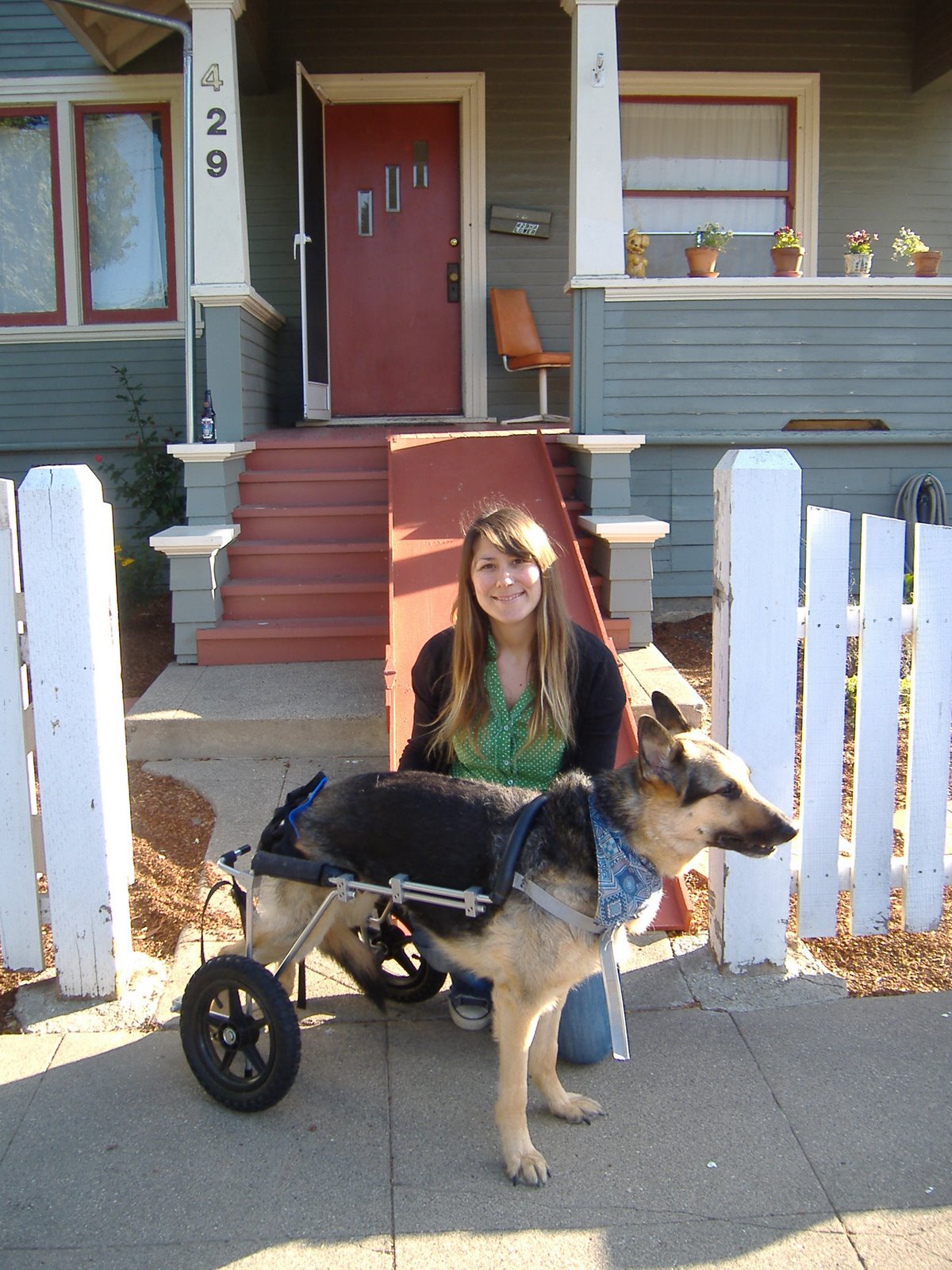
I am happy to report that the move went very well! Except for the unfortunate accident I had involving a beer bottle, my wrist, and a lot of blood. No, I wasn’t drunk! I wasn’t even drinking. I swear. I was unloading my van, trying to get Ali’s big orthopedic bed out, when an errant 6-pack started tumbling toward the door (in that weird combination of slow and fast motion). A couple bottles hurtled past me to the ground and smashed in the gutter and in my panicked attempt to keep more from falling somehow I caused another one to crack open and the jagged pieces hit my wrist on the way down. What a mess…glass and beer everywhere (hi, new neighbors)! Once the blood started gushing and I saw where the three main cuts were (one was right in the suicide place, scarily near my vein, and the other was so deep it would more accurately be described as a “gash”), I started to get faint and called my roommate Maggie at work, just so someone would know where I was in case I passed out and bled to death, and she came immediately with our dusty ALDF first aid kit and bandaged me right up. She is awesome!! Why is this relevant to my Ali blog? Well, it was my right wrist and it was really painful (not to mention disgusting) for a couple days and I need both my hands and arms to deal with Ali without hurting us, so it was tricky. But a little over a week later I am completely healed and trying to be much more careful around glass. Although I think I may be accident prone.
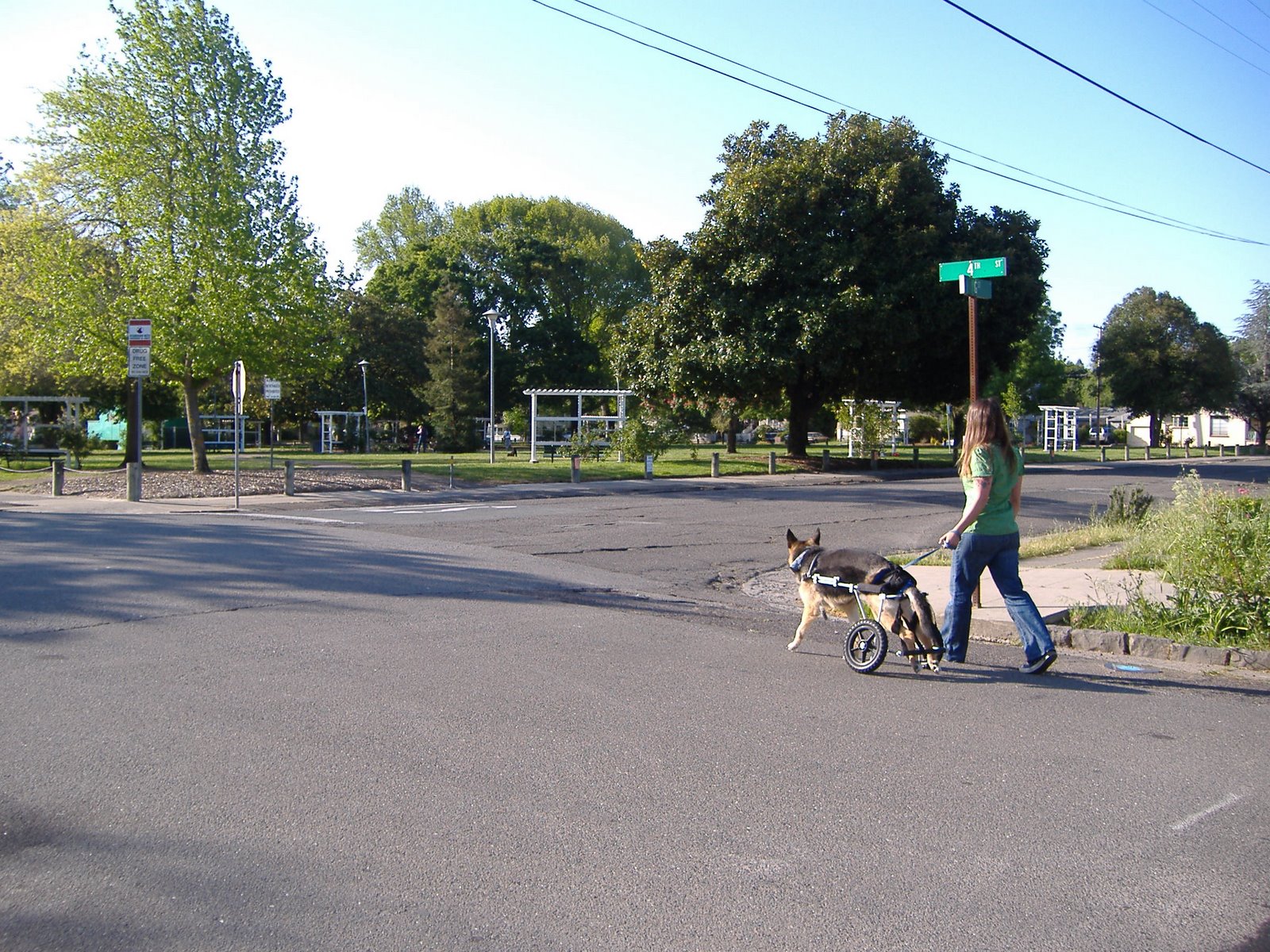
To get to the raison d’être of this blog, Ali is doing really well and has settled nicely at our new place in Petaluma. He is using the ramp successfully and the park across the street is very convenient for us. I take him there 3 times a day (2 on work days) to exercise, go potty, and do ten minutes of standing exercises in his cart. He and Rita, Maggie’s dog, are getting along great and I couldn’t ask for a better canine roommate for him right now. She is pretty low key which is good, because he wanted to play immediately when he met her, and when Ali plays he throws his whole body into and even likes to spin around (his infamous “play spins”), so I had to watch him pretty carefully to make sure he did not overexert himself. It has been interesting adjusting to life outside of one room, because of course he sometimes wants to travel from room to room, or greet Maggie and Rita when they come home, and meet new people when they come over. I have to watch him so he does not drag himself, which he definitely was trying to do a lot at first (and still does sometimes) and when he wants to get up I run over and grab him by his Walkabout rear harness (aka his “shepherd handles”), which I leave on him all day until we go to bed, and assist him by lifting his rear legs so he can walk where he wants using his front. The rest of the time he is on one of his beds. Getting to and from work has been a challenge (obviously compared to the convenience of living in my office, ho, ho, ho). Everything takes so much longer, getting him in and out of the car is kind of tricky (and making sure he doesn’t get himself into some weird position while I am driving), but we are getting into the new routine. Last week we were able to join in our first staff dog walk since his surgery over two months ago, which was great. The other dogs were not quite sure what to make of his wheelchair at first, but it didn’t stop Alec from his favorite activity while walking with a group dogs – trying to pull to the head of the pack so he can be the first one in what must appear to onlookers like a dog parade.
I still need to keep his walks short and it’s better for his joints if he walks on grass (hence the park across the street being so convenient), but Juli, his rehab therapist, says eventually he can take long walks in the cart. For now though, she emphasizes that physical therapy is the most important thing I can do with him in the cart, more important than going on walks, and I need to keep doing his exercises throughout the day. She showed me a new exercise where I assist him to sit and then stand several times throughout the day for one minute. She came by last weekend to help with his cart problems and showed me a way to get him to urinate in the cart and it is working so I am very happy about that! Moreover, she believes she see some slight movement at the top of his back legs, where they meet the rest of his body (this is called “proximal motor”). She also believes he has deep pain perception (I pinched his tail once in front of her and she saw him react – the reaction I could not get for the neurologist during our initial re-check exam back in March). Since Juli believes Ali is showing some improvement, she suggested I make an appointment at Animal Care Center with the Dr. Tieber for another re-check. She said because she is not a doctor she can only “assess” Ali’s condition but not “diagnose” and thinks I should get a neurologist’s opinion on what she believes she is observing (i.e. some return of motor function).
After we see the neurologist, Dr. Tieber, we are going to have a rehab appointment with Juli and put Ali in the hydro-therapy tank for the first time. I really hope Dr. Tieber confirms what Juli is seeing. I feel like he is improving too – it seems like I can see his legs moving slightly sometimes in the cart – but I am afraid to get my hopes too far up. Our appointment is on Friday morning. Wish us luck!!!
Cart is here…and it fits!
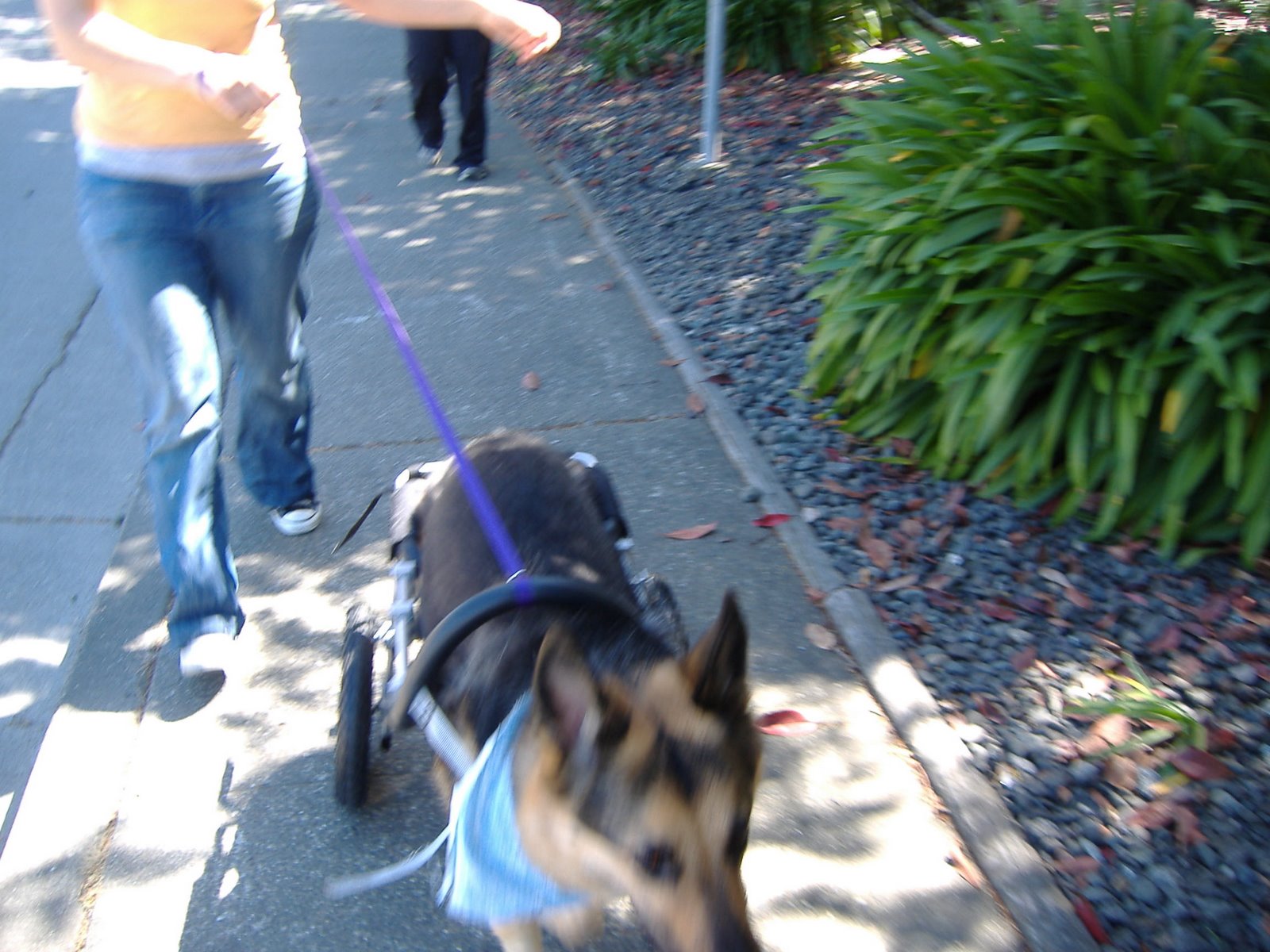
Ordered the cart today! Now we just have to wait 3 weeks…
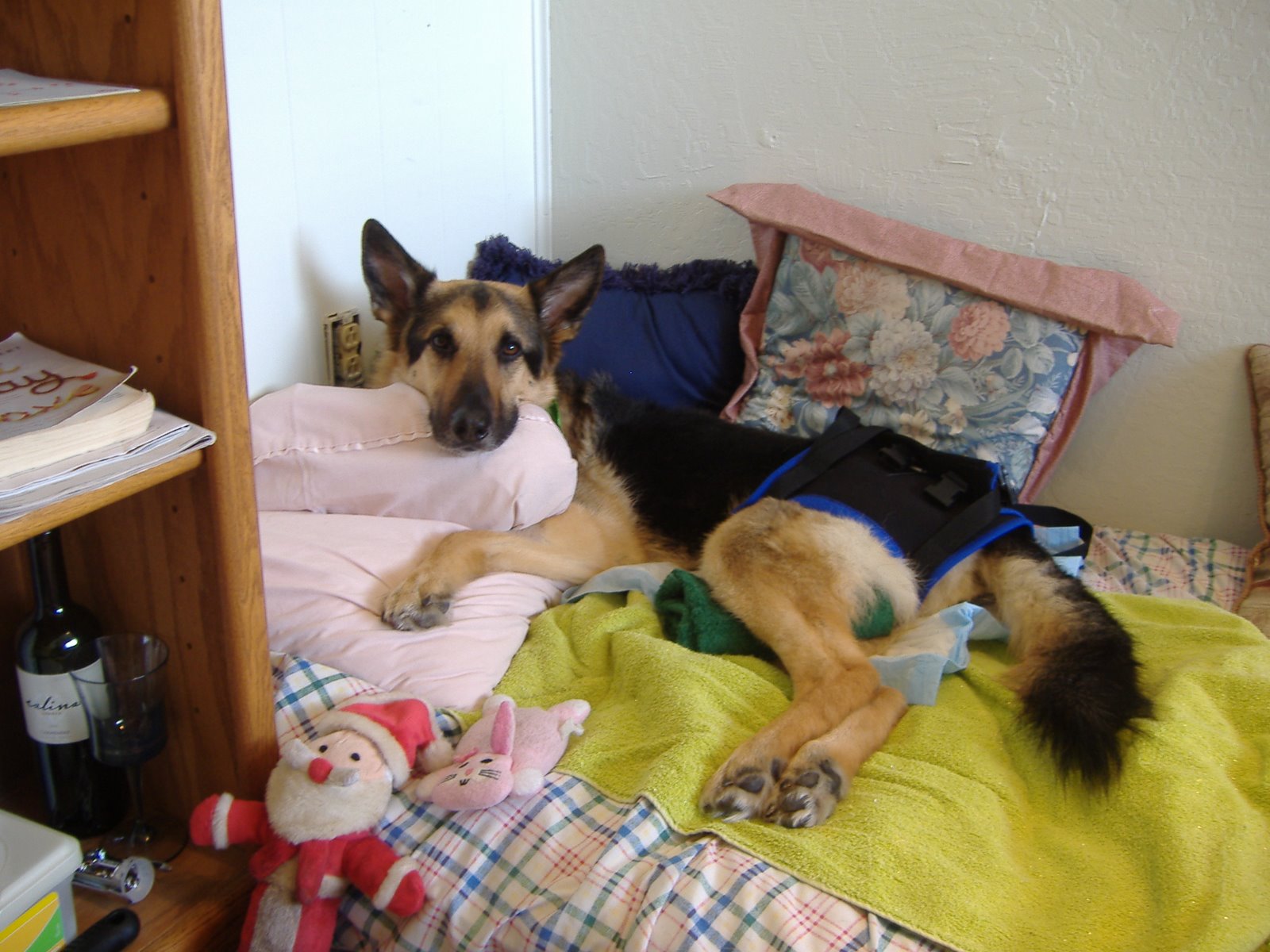
And Alec is still going to the bathroom outside a lot so I haven’t really been expressing his bladder. I tried once early this morning but did not try for the rest of the day – I just let him go outside on his own. To see how well he was emptying (or not), I asked Dr. Leavey to stop by on her way home this evening to check his bladder with a catheter and she extracted four tablespoons of urine, which is not very much. So signs seem good that he is mostly emptying on his own, which is amazing! Fingers crossed that this continues.
Going to the bathroom outside!
First re-check appointment:
Alec had his re-check appointment today; this was the first time he was back at Animal Care Center since he was discharged on 2/21. My wonderful friend April helped me load him into my van, which we did by sling walking him up a ramp, and the nurses wheeled him inside on a gurney when we got there. We saw the neurologist who performed his two surgeries, Dr. Lisa Tieber, and the canine rehabilitation specialist, Juli Dell’Era. Although I had sworn he felt it a few times when I pinched his tail recently, Alec would not react to pinches from Dr. Tieber so his prognosis was deemed “poor for return to normal function” based on his “persistent absence of deep pain.”
Today marks four weeks after his surgery and I know that most dogs who are going to regain deep pain perception (DPP) do so within a few weeks of surgery. Still, I also get the feeling from the studies I have read that there may not be a preponderance of long-term data. In one article I read* the authors studied 70 dogs with intervertebral disk disease (IVDD) and of this 70, six were euthanized at the time of the initial examination at the owner’s request and nine more were euthanized within one month after surgery. Although seven of these nine were euthanized because of suspected or confirmed ascending myelomalacia (a terminal condition in which the paralysis spreads throughout the body), the remaining two dogs were euthanized within three weeks after surgery at their owners’ request because of a lack of improvement. So in just this one study eight of 70 dogs (approximately 12%) were euthanized very early on either before surgery or soon after because they had not improved. Combined with the fact that large dogs represent the minority of cases of IVDD and take longer to recover, I would surmise that there is not a ton of data out there about dogs like Alec. The doctor herself said she has seen amazing things happen with physical therapy, so I am going to try everything for him.
Now, there is this phenomenon called “spinal walking” or “reflex walking,” which I think I mentioned in another entry. Without regaining DPP it is unlikely (impossible?) that a dog will recover normal function – meaning conscious control of their back legs. However, some dogs develop reflexes that allow them to walk without knowing they are doing it. I guess it relies mostly on muscle memory rather than conscious control. Dogs who develop this ability walk with a “drunken” or wobbly gait – not quite normal – but it’s enough to get them around. I asked Juli, the rehab therapist, if she had ever seen this ability develop in big dogs and she said she had a Doberman that became a “spinal walker.” So it is not impossible in large dogs. The study I referenced above included a few large breed dogs, including one German shepherd, but the vast majority were dachshunds and other small breeds, so it’s hard to draw conclusions based on Ali’s size, but in this study 37 of the remaining 64 dogs developed DPP and the ability to walk. Among the dogs that did not develop DPP, four were euthanized 2, 4, 9, and 36 months after surgery, again, due to a lack of improvement and one dog died as the result of an attack by another dog 6 months after injury (how awful!).
Of the remaining dogs, seven regained the ability to walk despite a lack of DPP (although the authors don’t call it this, I believe they are describing “spinal walking”). They don’t differentiate the breeds of these seven dogs so I don’t know whether any large breeds were represented in this number. All seven dogs who regained motor function had a voluntary tail wag one month after injury, and Alec started wagging his tail when I walked in the room about 2-3 weeks after surgery. The fact that I noticed he wagged his tail is what prompted me to hunt down this study, which has been very informative and also given me some hope that even with a lack of DPP, Alec could one day walk. The authors of this study believed the voluntary tail wag was a good prognostic indicator: “Persistent loss of DPP did not preclude recovery of motor function, and dogs that did recover motor function developed a voluntary tail wag within 4 weeks after the injury” (Olby et. al., 2003, p. 768).
Additionally, according to this study, the average time for dogs without DPP to develop motor function was 9 months. So whatever happens, this is going to be a long road. It also made me realize I absolutely could not go back to my place in San Francisco. Even though I knew this was likely, I was holding onto hope that somehow it could work and we could go home…but it’s impossible. After the appointment I told my roommates I am definitely moving out. We are all sad, but this is the only option right now. Besides the stairs in my place in SF, it makes sense for us to be up here in Sonoma County, closer to Alec’s doctors and he will be doing his physical therapy up here too. I guess I had known this for of a couple weeks, but it became final in my mind today. And today was the day I started saying it out loud. Good-bye San Francisco.
Something kind of cool: During the re-check exam, even though Alec did not demonstrate DPP, Dr. Tieber noticed that he started peeing on his own when we stood him up. She said “look he’s doing that on his own! I’m not touching him.” And she seemed excited about this fact. She asked if he had done this at home and I said I didn’t know; I never take my hands off his bladder when he starts peeing! I get so excited when I find the spot I don’t want to ease the pressure until he stops. She said this means he is perhaps developing a “reflexive bladder” where they can go on their own somewhat but still need to be expressed. I told her about our ongoing problems with him pooping in his bed, especially overnight, and trying to squat (which he can’t do because his legs don’t work) but only flattening it and rubbing it into his fur and bedding (gross, I know – but try cleaning it up everyday!) and she suggested walking him outside in a sling for 5 minutes after his meals. She said for some dogs just moving and being outside stimulates them to go to the bathroom. I am skeptical but I will try it!!
Finally, I really like Juli, the rehab specialist. She is very knowledgeable and also really nice. She said she treats all patients as if they will walk again so the therapy will be the same for Alec whether he has DPP or not. Like I mentioned above, Dr. Tieber said she has seen amazing things happen with physical therapy…so we have to try, right? If we forego physical therapy, it is virtually guaranteed nothing will change, but with therapy there is a chance we could see improvement. Another neurologist said early on after Alec’s surgery, in response to my question about physical therapy, “Well, if he has no DPP there is no point in doing physical therapy.” Now that I have educated myself some more, this doesn’t make sense to me. Even without DPP, according to the study I keep referencing, some dogs recover motor function. I asked Dr. Tieber why he would say that and she just said “well, we have different philosophies about that.”
The next step is to get Alec measured for a cart (doggie wheelchair). Juli said they can be great rehab tools as well a means of mobility. It will be awhile before he can really run around with his wheels since he is still recovering from surgery, but in the interim we can use it for his rehab exercises. Currently I am doing physical therapy with him at home a few times a day, including passive range of motion (PROM) and standing exercises to get him to bear weight on his back lets. The latter are hard to do by myself (wiggly, heavy German shepherd!) and Juli said the wheelie cart will really help with this. The problem is Alec is starting to overcompensate, putting too much weight on his front legs (unfortunately I wasn’t discouraging this because I just thought he was getting stronger up front – woops), and he is already developing arthritis so it is very important he distribute his weight more evenly. She said the cart will really help with this, balancing out his weight. The measurements for the cart have to be very precise (if you make a mistake in measuring and the cart doesn’t fit, you have to pay for a whole new one to be made! And they are around $600) so she wants to come to us to do the measurements so he will be as relaxed as possible. We will do that this weekend. Oh, and I suspect he has a urinary tract infection (malodorous urine) so we started a urine culture on that. We will see. I came home from this hours-long appointment with my head buzzing. I feel like it was a lot of information to take in all at once!
As an aside, Alec has gotten very “vocal” since this all happened, barking at everyone much more than he used to, louder and without stopping when I tell him to. He used to bark occasionally when he heard something (or saw another dog across the street), but nothing like this persistent barking. I think he is overcompensating because he can’t move and feels vulnerable. Well, today I left the exam room to use the restroom and when I came back Dr. Tieber walked in and he started barking like crazy. She told me she had come in only a moment before when I was not there and he hadn’t made a sound! Apparently there is a protective element to his barking, which I did not know because I am always there with him when he barks so I just assumed he did it all the time. Either way, I will have to figure out a way to get it under control. He was reasonably well-trained before this happened, but now it’s almost like I have to start all over again with certain things…
* Olby, Natasha, et. al., 2003, “Long-term functional outcome of dogs with severe injuries of the thoracolumbar spinal cord: 87 cases [1996-2001],” JAVMA, Vol. 222, No. 6, March 15.
A couple days ago it suddenly became really difficult to express Alec’s bladder, even though I had been doing fine the last few days. I know it’s not my technique because I can feel the “balloon” now under my hands and everything was going pretty well…then suddenly nothing! After my local vet, Dr. Leavey, checked and also found him hard to express, the doctors at Animal Care Center prescribed Phenoxybenzamine, which is a drug that relaxes the urethral sphincter. This drug cost $144 for a one week supply!!!!! Unbelievable… just my luck that he was prescribed the most expensive drug ever. I asked one of the neurologists if he would have to be on it for the rest of his life and she said quite possibly, but the other neurologist said no, it’s very rare that a dog would have to be on it for a long duration and that the plan should be to wean him off it, if and when expressing starts to be easier again. Luckily I accidentally gave him only half the prescribed dose the first night and I found he was already easier to express the next day. I am keeping it at this dose and within a few days will scale back if he improves. I called Costco pharmacy, which is supposed to be the cheapest option, and they will only order this drug in bottles of 100 pills, which costs over $600 per bottle!! I really hope he does not have to be on this for the rest of his life. 😦
On a happier note, I walked in the room yesterday and Alec looked at me and wagged his tail! I got really excited. I don’t know if it means anything, but I will investigate. Either way, it sure was nice to see it wag again!! He does this thing where if I walk in the room he will just wag the tip of his tail. It’s really cute – I call it his “rattlesnake tail.” Well, that’s what he did. It was pretty cool.
Filed under $$$, Bladder Expression/Urination, Medications, Milestones/Progress


 Alec's Story

